
Real UK Feedback and Prive Casino Reviews
Prive Casino UK Guide
As of August 2026, Prive Casino’s Trustpilot profile showed a TrustScore of 3.5 out of 5 based on eight reviews. That is a small sample, so it is more useful as a set of individual experience signals than as a stable verdict on the casino. The distribution was also polarised: 62% of the eight reviews were five-star and 38% were one-star, with no ratings in the middle categories in that August 2026 sample. A separate Casino Guru record contained only a small number of player reviews but listed several complaint cases. The sensible reading is to examine themes, dates and outcomes, then keep those opinions separate from licence and regulator records.
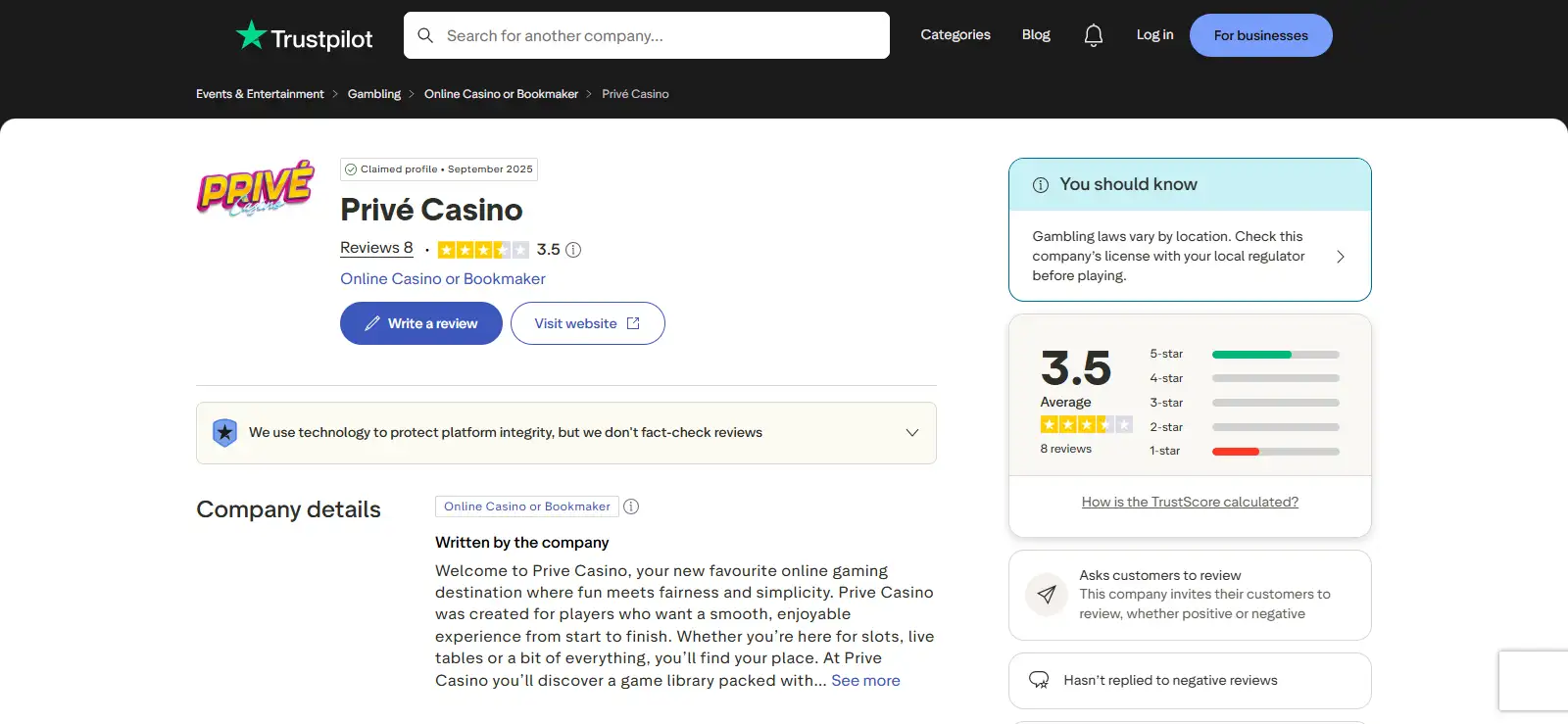
Table of Contents
- Analyzing Prive Casino Trustpilot Ratings and Complaints
- What the positive reviews actually say
- Complaint records point to account and withdrawal friction
- Small samples can produce extreme-looking percentages
- Review platforms answer a different question from regulators
- How to read an individual complaint
- Keep your own records if you decide to use the site
- What the August 2026 review sample cannot prove
- Reviews are most useful when combined with your own priorities
- Why dates matter for Prive Casino
- Cross-check reviews against the regulator and live terms
- Cross-check themes instead of chasing a single score
- Complaint status needs context
- Recent reviews deserve more weight than old interface comments
- The current review sample points to caution, not a universal verdict
Analyzing Prive Casino Trustpilot Ratings and Complaints
A 3.5 score can look precise, but eight reviews do not provide the depth of data that a large, long-running review profile would. One additional review can materially change both the average and the star distribution. The profile is therefore best treated as a dated view rather than a permanent reputation score.
Trustpilot also allows reviewers to edit or delete their reviews, and the platform displays reviews while the account remains active. That is another reason to record the date and sample size together. A score without its denominator can make a thin sample look much more authoritative than it is.
What the positive reviews actually say
The visible positive Trustpilot reviews in the current set of reviews praise broad product and service qualities. One reviewer described the layout, loading speed and game variety positively. Other short reviews praised the bonus, games, communication and support. These comments are useful for identifying what satisfied reviewers noticed, but they are not independent technical tests of game fairness, payment security or regulatory compliance.
Two of the visible positive reviews were marked verified on Trustpilot, while other visible entries were labelled unprompted. Those labels add context to how the review was collected; they do not turn an individual opinion into a guarantee that another customer’s experience will match it.
Complaint records point to account and withdrawal friction
Casino Guru’s Prive Casino record adds a different kind of reputation data because it lists complaint cases rather than only star ratings. The current record shows seven complaint entries in total, including cases concerning rejected or delayed access to money, blocked or closed accounts and confiscated winnings. Three were shown as unresolved and four as rejected in the August 2026 record.
Those case labels should be read carefully. A complaint being listed does not prove every allegation made by the player, and a rejected complaint is not the same thing as a finding against the casino. What the records do show is which areas have generated disputes worth examining before you deposit.
Withdrawal and account-control themes are especially relevant because they can intersect with verification. If that is your main concern, use the Prive Casino withdrawal guide for the operational checks rather than relying on review comments to supply exact processing times or limits.
Small samples can produce extreme-looking percentages
The 62% five-star and 38% one-star split looks dramatic because there are only eight Trustpilot reviews. With a sample this small, percentages can hide the underlying count. It is clearer to remember that the profile contains a handful of experiences rather than a broad survey of the customer base.
The absence of two-, three- and four-star reviews in the August 2026 sample also means the profile has little middle-ground feedback. That may change as more reviews arrive. It should not be interpreted as proof that experiences are always either excellent or terrible.
Review platforms answer a different question from regulators
User reviews answer, “What did these reviewers say happened to them?” A licence register answers, “Which entity and domain does the regulator currently record under a licence?” Those are different questions and should not be merged.
For Prive Casino, the licence and trust guide records the current Anjouan licence record and the separate UKGC register position. A positive Trustpilot review cannot establish a UKGC licence. Likewise, a negative review cannot by itself erase a valid Anjouan register entry. Keeping these source types separate produces a more useful assessment than trying to turn all signals into one trust score.
How to read an individual complaint
- Check the date of the complaint and whether the issue is recent enough to reflect the current operator and terms.
- Identify the actual dispute: withdrawal, KYC, bonus terms, account closure, support or something else.
- Look for the amount in dispute and whether the reviewer describes a sequence of events rather than only a conclusion.
- Check whether the casino responded and whether the platform records a resolution or rejection.
- Separate claims that can be independently checked from opinions about service quality.
- Do not copy an exact processing time, withdrawal limit or KYC requirement from a complaint and treat it as a current rule.
This approach turns reviews into decision signals without assuming that every reviewer is correct or that every case will repeat.
Keep your own records if you decide to use the site
Complaint analysis is most useful before a problem occurs. If account closure, verification or withdrawals appear repeatedly in the records you read, prepare for those areas by keeping clear documentation. Save the promotion terms you accepted, transaction confirmations, KYC submission receipts and relevant support conversations.
When asking support to resolve a problem, use dates, transaction references and the exact action you need. A chronological record is easier to escalate than a long conversation reconstructed from memory. It also makes it easier to distinguish a routine verification request from a process that has stalled.
What the August 2026 review sample cannot prove
| Signal | Reasonable reading | Do not infer |
|---|---|---|
| 3.5/5 on Trustpilot | A mixed-to-positive average in a very small current set of reviews | That the casino has a stable 3.5 reputation across all customers |
| 62% five-star | Several reviewers in the sample reported positive experiences | That 62% of all customers are highly satisfied |
| 38% one-star | A meaningful minority of this tiny sample reported strongly negative experiences | That 38% of all customers will have a serious problem |
| Complaint cases | Account, withdrawal and winnings disputes deserve attention | That every allegation was proven against the operator |
Reviews are most useful when combined with your own priorities
If fast cash-out is your priority, focus on withdrawal-related cases and then compare them with the current cashier and terms. If support quality matters most, read recent service comments and test the available support channel with a specific pre-deposit question. If promotions matter, look for disputes about bonus rules but verify the live terms separately.
This is more useful than counting positive and negative reviews indiscriminately. A complaint about a feature you will never use may be less relevant to your decision than a repeated issue in the exact process you care about.
Why dates matter for Prive Casino
Prive Casino is a relatively recent brand in the available information set, and its operator and licence position should be checked using current records. Reputation data is similarly time-sensitive. A review from a previous operating setup, or a rating recorded before a burst of new reviews, can quickly become less representative.
For that reason, the August 2026 figures should be treated as a time-specific snapshot rather than a permanent platform score. Before relying on the numbers later, open the live review profile and compare the current count, distribution and newest entries with the August 2026 sample.
Cross-check reviews against the regulator and live terms
Start with the current regulator and operator record, then read the newest reviews rather than only the highest-ranked ones. Sample at least one positive and one negative account, check whether complaint themes overlap, and verify any operational claim against the live site or terms. Finally, decide whether the unresolved questions affect the amount you are willing to deposit or the features you plan to use.
Return to the Prive Casino UK review for the broader product assessment. Reviews are one layer of that decision, not a substitute for current licence, payment and account information.
Cross-check themes instead of chasing a single score
A useful reputation check compares more than one type of public record. Trustpilot currently provides a small star-rating sample. Casino Guru provides a separate complaint log and its own editorial assessment. Agreement between them on a specific experience theme can make that theme worth investigating, but the platforms still use different submission, moderation and scoring systems.
For example, a withdrawal complaint should prompt you to inspect current withdrawal and verification terms. It should not be converted into a universal statement that withdrawals always fail. Likewise, a positive comment about fast support reflects one reviewer’s experience, not a service-level guarantee. The goal is to identify questions that survive across sources and then test those questions against primary information.
Complaint status needs context
Casino Guru currently labels some Prive complaint cases unresolved and others rejected. Those labels describe the platform’s case-handling outcome, not a court or regulator ruling. An unresolved case can indicate that the platform did not reach a satisfactory resolution; a rejected case can arise for reasons specific to the complaint or the platform’s rules. Read the case detail before treating the label as a judgement about the operator.
The disputed amounts shown in complaint records also vary widely. Amount size can help you understand the practical stakes of a case, but it does not establish whether the player’s account is accurate. The more transferable signal is the process involved: what happened after a withdrawal request, what verification was requested, how support responded and whether the account remained accessible.
Recent reviews deserve more weight than old interface comments
Comments about layout, loading speed, available games and support channels can age quickly because websites and operating arrangements change. When comparing reviews, give more weight to recent observations about the current domain and operator, especially for interface and service questions. Older reports can still matter when they document a long-running dispute theme, but check whether the same issue appears in newer reports.
Also confirm that you are reading the profile for prive.casino rather than a similarly named gambling site. Reputation analysis is particularly vulnerable to name confusion, and a review profile for another domain should not be merged into Prive Casino’s record.
The current review sample points to caution, not a universal verdict
The current public review data is limited and mixed. Trustpilot shows a 3.5/5 score from eight reviews, with a sharply polarised star distribution. Casino Guru’s complaint record adds cases involving withdrawals, blocked or closed accounts and winnings disputes. Those signals justify closer checks around account and cash-out processes, but the small samples do not support a sweeping claim that every customer will have either a good or bad experience.
Use the reviews to identify questions to verify, keep regulator records separate, and preserve your own records if you choose to create an account. That produces a more defensible decision than treating a single rating as the answer.
Created by the ”Prive Casino” editorial team.